Last Updated: 3/7/2026


Python
Get started
Capabilities
Production
LangGraph APIs
Memory
Add short-term memory
`from langgraph.checkpoint.memory import InMemorySaver from langgraph.graph import StateGraph
checkpointer = InMemorySaver()
builder = StateGraph(…) graph = builder.compile(checkpointer=checkpointer)
graph.invoke( {“messages”: [{“role”: “user”, “content”: “hi! i am Bob”}]}, {“configurable”: {“thread_id”: “1”}}, )`
Use in production
`from langgraph.checkpoint.postgres import PostgresSaver
DB_URI = “postgresql://postgres:postgres@localhost:5442/postgres?sslmode=disable” with PostgresSaver.from_conn_string(DB_URI) as checkpointer: builder = StateGraph(…) graph = builder.compile(checkpointer=checkpointer)`
Example: using Postgres checkpointer
pip install -U "psycopg[binary,pool]" langgraph langgraph-checkpoint-postgres
checkpointer.setup()
`from langchain.chat_models import init_chat_model
from langgraph.graph import StateGraph, MessagesState, START
from langgraph.checkpoint.postgres import PostgresSaver
model = init_chat_model(model=“claude-haiku-4-5-20251001”)
DB_URI = “postgresql://postgres:postgres@localhost:5442/postgres?sslmode=disable” with PostgresSaver.from_conn_string(DB_URI) as checkpointer:
checkpointer.setup()
def call_model(state: MessagesState): response = model.invoke(state[“messages”]) return {“messages”: response}
builder = StateGraph(MessagesState) builder.add_node(call_model) builder.add_edge(START, “call_model”)
graph = builder.compile(checkpointer=checkpointer)
config = { “configurable”: { “thread_id”: “1” } }
for chunk in graph.stream( {“messages”: [{“role”: “user”, “content”: “hi! I’m bob”}]}, config, stream_mode=“values” ): chunk[“messages”][-1].pretty_print()
for chunk in graph.stream(
{“messages”: [{“role”: “user”, “content”: “what’s my name?”}]},
config,
stream_mode=“values”
):
chunk[“messages”][-1].pretty_print() from langchain.chat_models import init_chat_model
from langgraph.graph import StateGraph, MessagesState, START
from langgraph.checkpoint.postgres.aio import AsyncPostgresSaver
model = init_chat_model(model=“claude-haiku-4-5-20251001”)
DB_URI = “postgresql://postgres:postgres@localhost:5442/postgres?sslmode=disable” async with AsyncPostgresSaver.from_conn_string(DB_URI) as checkpointer:
await checkpointer.setup()
async def call_model(state: MessagesState): response = await model.ainvoke(state[“messages”]) return {“messages”: response}
builder = StateGraph(MessagesState) builder.add_node(call_model) builder.add_edge(START, “call_model”)
graph = builder.compile(checkpointer=checkpointer)
config = { “configurable”: { “thread_id”: “1” } }
async for chunk in graph.astream( {“messages”: [{“role”: “user”, “content”: “hi! I’m bob”}]}, config, stream_mode=“values” ): chunk[“messages”][-1].pretty_print()
async for chunk in graph.astream( {“messages”: [{“role”: “user”, “content”: “what’s my name?”}]}, config, stream_mode=“values” ): chunk[“messages”][-1].pretty_print()`
Example: using MongoDB checkpointer
pip install -U pymongo langgraph langgraph-checkpoint-mongodb
`from langchain.chat_models import init_chat_model
from langgraph.graph import StateGraph, MessagesState, START
from langgraph.checkpoint.mongodb import MongoDBSaver
model = init_chat_model(model=“claude-haiku-4-5-20251001”)
DB_URI = “localhost:27017” with MongoDBSaver.from_conn_string(DB_URI) as checkpointer:
def call_model(state: MessagesState): response = model.invoke(state[“messages”]) return {“messages”: response}
builder = StateGraph(MessagesState) builder.add_node(call_model) builder.add_edge(START, “call_model”)
graph = builder.compile(checkpointer=checkpointer)
config = { “configurable”: { “thread_id”: “1” } }
for chunk in graph.stream( {“messages”: [{“role”: “user”, “content”: “hi! I’m bob”}]}, config, stream_mode=“values” ): chunk[“messages”][-1].pretty_print()
for chunk in graph.stream(
{“messages”: [{“role”: “user”, “content”: “what’s my name?”}]},
config,
stream_mode=“values”
):
chunk[“messages”][-1].pretty_print() from langchain.chat_models import init_chat_model
from langgraph.graph import StateGraph, MessagesState, START
from langgraph.checkpoint.mongodb.aio import AsyncMongoDBSaver
model = init_chat_model(model=“claude-haiku-4-5-20251001”)
DB_URI = “localhost:27017” async with AsyncMongoDBSaver.from_conn_string(DB_URI) as checkpointer:
async def call_model(state: MessagesState): response = await model.ainvoke(state[“messages”]) return {“messages”: response}
builder = StateGraph(MessagesState) builder.add_node(call_model) builder.add_edge(START, “call_model”)
graph = builder.compile(checkpointer=checkpointer)
config = { “configurable”: { “thread_id”: “1” } }
async for chunk in graph.astream( {“messages”: [{“role”: “user”, “content”: “hi! I’m bob”}]}, config, stream_mode=“values” ): chunk[“messages”][-1].pretty_print()
async for chunk in graph.astream( {“messages”: [{“role”: “user”, “content”: “what’s my name?”}]}, config, stream_mode=“values” ): chunk[“messages”][-1].pretty_print()`
Example: using Redis checkpointer
pip install -U langgraph langgraph-checkpoint-redis
checkpointer.setup()
`from langchain.chat_models import init_chat_model
from langgraph.graph import StateGraph, MessagesState, START
from langgraph.checkpoint.redis import RedisSaver
model = init_chat_model(model=“claude-haiku-4-5-20251001”)
DB_URI = “redis://localhost:6379” with RedisSaver.from_conn_string(DB_URI) as checkpointer:
checkpointer.setup()
def call_model(state: MessagesState): response = model.invoke(state[“messages”]) return {“messages”: response}
builder = StateGraph(MessagesState) builder.add_node(call_model) builder.add_edge(START, “call_model”)
graph = builder.compile(checkpointer=checkpointer)
config = { “configurable”: { “thread_id”: “1” } }
for chunk in graph.stream( {“messages”: [{“role”: “user”, “content”: “hi! I’m bob”}]}, config, stream_mode=“values” ): chunk[“messages”][-1].pretty_print()
for chunk in graph.stream(
{“messages”: [{“role”: “user”, “content”: “what’s my name?”}]},
config,
stream_mode=“values”
):
chunk[“messages”][-1].pretty_print() from langchain.chat_models import init_chat_model
from langgraph.graph import StateGraph, MessagesState, START
from langgraph.checkpoint.redis.aio import AsyncRedisSaver
model = init_chat_model(model=“claude-haiku-4-5-20251001”)
DB_URI = “redis://localhost:6379” async with AsyncRedisSaver.from_conn_string(DB_URI) as checkpointer:
await checkpointer.asetup()
async def call_model(state: MessagesState): response = await model.ainvoke(state[“messages”]) return {“messages”: response}
builder = StateGraph(MessagesState) builder.add_node(call_model) builder.add_edge(START, “call_model”)
graph = builder.compile(checkpointer=checkpointer)
config = { “configurable”: { “thread_id”: “1” } }
async for chunk in graph.astream( {“messages”: [{“role”: “user”, “content”: “hi! I’m bob”}]}, config, stream_mode=“values” ): chunk[“messages”][-1].pretty_print()
async for chunk in graph.astream( {“messages”: [{“role”: “user”, “content”: “what’s my name?”}]}, config, stream_mode=“values” ): chunk[“messages”][-1].pretty_print()`
Use in subgraphs
`from langgraph.graph import START, StateGraph from langgraph.checkpoint.memory import InMemorySaver from typing import TypedDict
class State(TypedDict): foo: str
Subgraph
def subgraph_node_1(state: State): return {“foo”: state[“foo”] + “bar”}
subgraph_builder = StateGraph(State) subgraph_builder.add_node(subgraph_node_1) subgraph_builder.add_edge(START, “subgraph_node_1”) subgraph = subgraph_builder.compile()
Parent graph
builder = StateGraph(State) builder.add_node(“node_1”, subgraph) builder.add_edge(START, “node_1”)
checkpointer = InMemorySaver()
graph = builder.compile(checkpointer=checkpointer) subgraph_builder = StateGraph(…)
subgraph = subgraph_builder.compile(checkpointer=True)`
Add long-term memory
`from langgraph.store.memory import InMemoryStore from langgraph.graph import StateGraph
store = InMemoryStore()
builder = StateGraph(…) graph = builder.compile(store=store)`
Access the store inside nodes
Runtime
`from dataclasses import dataclass
from langgraph.runtime import Runtime
from langgraph.graph import StateGraph, MessagesState, START
import uuid
@dataclass class Context: user_id: str
async def call_model(state: MessagesState, runtime: Runtime[Context]): user_id = runtime.context.user_id namespace = (user_id, “memories”)
Search for relevant memories
memories = await runtime.store.asearch( namespace, query=state[“messages”][-1].content, limit=3 ) info = “\n”.join([d.value[“data”] for d in memories])
… Use memories in model call
Store a new memory
await runtime.store.aput( namespace, str(uuid.uuid4()), {“data”: “User prefers dark mode”} )
builder = StateGraph(MessagesState, context_schema=Context) builder.add_node(call_model) builder.add_edge(START, “call_model”) graph = builder.compile(store=store)
Pass context at invocation time
graph.invoke( {“messages”: [{“role”: “user”, “content”: “hi”}]}, {“configurable”: {“thread_id”: “1”}}, context=Context(user_id=“1”), )`
Use in production
`from langgraph.store.postgres import PostgresStore
DB_URI = “postgresql://postgres:postgres@localhost:5442/postgres?sslmode=disable” with PostgresStore.from_conn_string(DB_URI) as store: builder = StateGraph(…) graph = builder.compile(store=store)`
Example: using Postgres store
pip install -U "psycopg[binary,pool]" langgraph langgraph-checkpoint-postgres
store.setup()
`from dataclasses import dataclass
from langchain.chat_models import init_chat_model
from langgraph.graph import StateGraph, MessagesState, START
from langgraph.checkpoint.postgres.aio import AsyncPostgresSaver
from langgraph.store.postgres.aio import AsyncPostgresStore
from langgraph.runtime import Runtime
import uuid
model = init_chat_model(model=“claude-haiku-4-5-20251001”)
@dataclass class Context: user_id: str
async def call_model( state: MessagesState, runtime: Runtime[Context], ): user_id = runtime.context.user_id namespace = (“memories”, user_id) memories = await runtime.store.asearch(namespace, query=str(state[“messages”][-1].content)) info = “\n”.join([d.value[“data”] for d in memories]) system_msg = f”You are a helpful assistant talking to the user. User info: {info}“
Store new memories if the user asks the model to remember
last_message = state[“messages”][-1] if “remember” in last_message.content.lower(): memory = “User name is Bob” await runtime.store.aput(namespace, str(uuid.uuid4()), {“data”: memory})
response = await model.ainvoke( [{“role”: “system”, “content”: system_msg}] + state[“messages”] ) return {“messages”: response}
DB_URI = “postgresql://postgres:postgres@localhost:5442/postgres?sslmode=disable”
async with ( AsyncPostgresStore.from_conn_string(DB_URI) as store, AsyncPostgresSaver.from_conn_string(DB_URI) as checkpointer, ):
await store.setup()
await checkpointer.setup()
builder = StateGraph(MessagesState, context_schema=Context) builder.add_node(call_model) builder.add_edge(START, “call_model”)
graph = builder.compile( checkpointer=checkpointer, store=store, )
config = {“configurable”: {“thread_id”: “1”}} async for chunk in graph.astream( {“messages”: [{“role”: “user”, “content”: “Hi! Remember: my name is Bob”}]}, config, stream_mode=“values”, context=Context(user_id=“1”), ): chunk[“messages”][-1].pretty_print()
config = {“configurable”: {“thread_id”: “2”}}
async for chunk in graph.astream(
{“messages”: [{“role”: “user”, “content”: “what is my name?”}]},
config,
stream_mode=“values”,
context=Context(user_id=“1”),
):
chunk[“messages”][-1].pretty_print() from dataclasses import dataclass
from langchain.chat_models import init_chat_model
from langgraph.graph import StateGraph, MessagesState, START
from langgraph.checkpoint.postgres import PostgresSaver
from langgraph.store.postgres import PostgresStore
from langgraph.runtime import Runtime
import uuid
model = init_chat_model(model=“claude-haiku-4-5-20251001”)
@dataclass class Context: user_id: str
def call_model( state: MessagesState, runtime: Runtime[Context], ): user_id = runtime.context.user_id namespace = (“memories”, user_id) memories = runtime.store.search(namespace, query=str(state[“messages”][-1].content)) info = “\n”.join([d.value[“data”] for d in memories]) system_msg = f”You are a helpful assistant talking to the user. User info: {info}“
Store new memories if the user asks the model to remember
last_message = state[“messages”][-1] if “remember” in last_message.content.lower(): memory = “User name is Bob” runtime.store.put(namespace, str(uuid.uuid4()), {“data”: memory})
response = model.invoke( [{“role”: “system”, “content”: system_msg}] + state[“messages”] ) return {“messages”: response}
DB_URI = “postgresql://postgres:postgres@localhost:5442/postgres?sslmode=disable”
with ( PostgresStore.from_conn_string(DB_URI) as store, PostgresSaver.from_conn_string(DB_URI) as checkpointer, ):
store.setup()
checkpointer.setup()
builder = StateGraph(MessagesState, context_schema=Context) builder.add_node(call_model) builder.add_edge(START, “call_model”)
graph = builder.compile( checkpointer=checkpointer, store=store, )
config = {“configurable”: {“thread_id”: “1”}} for chunk in graph.stream( {“messages”: [{“role”: “user”, “content”: “Hi! Remember: my name is Bob”}]}, config, stream_mode=“values”, context=Context(user_id=“1”), ): chunk[“messages”][-1].pretty_print()
config = {“configurable”: {“thread_id”: “2”}} for chunk in graph.stream( {“messages”: [{“role”: “user”, “content”: “what is my name?”}]}, config, stream_mode=“values”, context=Context(user_id=“1”), ): chunk[“messages”][-1].pretty_print()`
Example: using Redis store
pip install -U langgraph langgraph-checkpoint-redis
store.setup()
`from dataclasses import dataclass
from langchain.chat_models import init_chat_model
from langgraph.graph import StateGraph, MessagesState, START
from langgraph.checkpoint.redis.aio import AsyncRedisSaver
from langgraph.store.redis.aio import AsyncRedisStore
from langgraph.runtime import Runtime
import uuid
model = init_chat_model(model=“claude-haiku-4-5-20251001”)
@dataclass class Context: user_id: str
async def call_model( state: MessagesState, runtime: Runtime[Context], ): user_id = runtime.context.user_id namespace = (“memories”, user_id) memories = await runtime.store.asearch(namespace, query=str(state[“messages”][-1].content)) info = “\n”.join([d.value[“data”] for d in memories]) system_msg = f”You are a helpful assistant talking to the user. User info: {info}“
Store new memories if the user asks the model to remember
last_message = state[“messages”][-1] if “remember” in last_message.content.lower(): memory = “User name is Bob” await runtime.store.aput(namespace, str(uuid.uuid4()), {“data”: memory})
response = await model.ainvoke( [{“role”: “system”, “content”: system_msg}] + state[“messages”] ) return {“messages”: response}
DB_URI = “redis://localhost:6379”
async with ( AsyncRedisStore.from_conn_string(DB_URI) as store, AsyncRedisSaver.from_conn_string(DB_URI) as checkpointer, ):
await store.setup()
await checkpointer.asetup()
builder = StateGraph(MessagesState, context_schema=Context) builder.add_node(call_model) builder.add_edge(START, “call_model”)
graph = builder.compile( checkpointer=checkpointer, store=store, )
config = {“configurable”: {“thread_id”: “1”}} async for chunk in graph.astream( {“messages”: [{“role”: “user”, “content”: “Hi! Remember: my name is Bob”}]}, config, stream_mode=“values”, context=Context(user_id=“1”), ): chunk[“messages”][-1].pretty_print()
config = {“configurable”: {“thread_id”: “2”}}
async for chunk in graph.astream(
{“messages”: [{“role”: “user”, “content”: “what is my name?”}]},
config,
stream_mode=“values”,
context=Context(user_id=“1”),
):
chunk[“messages”][-1].pretty_print() from dataclasses import dataclass
from langchain.chat_models import init_chat_model
from langgraph.graph import StateGraph, MessagesState, START
from langgraph.checkpoint.redis import RedisSaver
from langgraph.store.redis import RedisStore
from langgraph.runtime import Runtime
import uuid
model = init_chat_model(model=“claude-haiku-4-5-20251001”)
@dataclass class Context: user_id: str
def call_model( state: MessagesState, runtime: Runtime[Context], ): user_id = runtime.context.user_id namespace = (“memories”, user_id) memories = runtime.store.search(namespace, query=str(state[“messages”][-1].content)) info = “\n”.join([d.value[“data”] for d in memories]) system_msg = f”You are a helpful assistant talking to the user. User info: {info}“
Store new memories if the user asks the model to remember
last_message = state[“messages”][-1] if “remember” in last_message.content.lower(): memory = “User name is Bob” runtime.store.put(namespace, str(uuid.uuid4()), {“data”: memory})
response = model.invoke( [{“role”: “system”, “content”: system_msg}] + state[“messages”] ) return {“messages”: response}
DB_URI = “redis://localhost:6379”
with ( RedisStore.from_conn_string(DB_URI) as store, RedisSaver.from_conn_string(DB_URI) as checkpointer, ): store.setup() checkpointer.setup()
builder = StateGraph(MessagesState, context_schema=Context) builder.add_node(call_model) builder.add_edge(START, “call_model”)
graph = builder.compile( checkpointer=checkpointer, store=store, )
config = {“configurable”: {“thread_id”: “1”}} for chunk in graph.stream( {“messages”: [{“role”: “user”, “content”: “Hi! Remember: my name is Bob”}]}, config, stream_mode=“values”, context=Context(user_id=“1”), ): chunk[“messages”][-1].pretty_print()
config = {“configurable”: {“thread_id”: “2”}} for chunk in graph.stream( {“messages”: [{“role”: “user”, “content”: “what is my name?”}]}, config, stream_mode=“values”, context=Context(user_id=“1”), ): chunk[“messages”][-1].pretty_print()`
Use semantic search
`from langchain.embeddings import init_embeddings from langgraph.store.memory import InMemoryStore
Create store with semantic search enabled
embeddings = init_embeddings(“openai:text-embedding-3-small”) store = InMemoryStore( index={ “embed”: embeddings, “dims”: 1536, } )
store.put((“user_123”, “memories”), “1”, {“text”: “I love pizza”}) store.put((“user_123”, “memories”), “2”, {“text”: “I am a plumber”})
items = store.search( (“user_123”, “memories”), query=“I’m hungry”, limit=1 )`
Long-term memory with semantic search
`from langchain.embeddings import init_embeddings from langchain.chat_models import init_chat_model from langgraph.store.memory import InMemoryStore from langgraph.graph import START, MessagesState, StateGraph from langgraph.runtime import Runtime
model = init_chat_model(“gpt-4.1-mini”)
Create store with semantic search enabled
embeddings = init_embeddings(“openai:text-embedding-3-small”) store = InMemoryStore( index={ “embed”: embeddings, “dims”: 1536, } )
store.put((“user_123”, “memories”), “1”, {“text”: “I love pizza”}) store.put((“user_123”, “memories”), “2”, {“text”: “I am a plumber”})
async def chat(state: MessagesState, runtime: Runtime):
Search based on user’s last message
items = await runtime.store.asearch( (“user_123”, “memories”), query=state[“messages”][-1].content, limit=2 ) memories = “\n”.join(item.value[“text”] for item in items) memories = f”## Memories of user\n{memories}” if memories else "" response = await model.ainvoke( [ {“role”: “system”, “content”: f”You are a helpful assistant.\n{memories}”}, *state[“messages”], ] ) return {“messages”: [response]}
builder = StateGraph(MessagesState) builder.add_node(chat) builder.add_edge(START, “chat”) graph = builder.compile(store=store)
async for message, metadata in graph.astream( input={“messages”: [{“role”: “user”, “content”: “I’m hungry”}]}, stream_mode=“messages”, ): print(message.content, end="")`
Manage short-term memory
Trim messages
strategy
max_tokens
trim_messages
`from langchain_core.messages.utils import (
trim_messages,
count_tokens_approximately
)
def call_model(state: MessagesState): messages = trim_messages( state[“messages”], strategy=“last”, token_counter=count_tokens_approximately, max_tokens=128, start_on=“human”, end_on=(“human”, “tool”), ) response = model.invoke(messages) return {“messages”: [response]}
builder = StateGraph(MessagesState) builder.add_node(call_model) …`
Full example: trim messages
`from langchain_core.messages.utils import ( trim_messages, count_tokens_approximately ) from langchain.chat_models import init_chat_model from langgraph.graph import StateGraph, START, MessagesState
model = init_chat_model(“claude-sonnet-4-5-20250929”) summarization_model = model.bind(max_tokens=128)
def call_model(state: MessagesState): messages = trim_messages( state[“messages”], strategy=“last”, token_counter=count_tokens_approximately, max_tokens=128, start_on=“human”, end_on=(“human”, “tool”), ) response = model.invoke(messages) return {“messages”: [response]}
checkpointer = InMemorySaver() builder = StateGraph(MessagesState) builder.add_node(call_model) builder.add_edge(START, “call_model”) graph = builder.compile(checkpointer=checkpointer)
config = {“configurable”: {“thread_id”: “1”}} graph.invoke({“messages”: “hi, my name is bob”}, config) graph.invoke({“messages”: “write a short poem about cats”}, config) graph.invoke({“messages”: “now do the same but for dogs”}, config) final_response = graph.invoke({“messages”: “what’s my name?”}, config)
final_response[“messages”][-1].pretty_print() ================================== Ai Message ==================================
Your name is Bob, as you mentioned when you first introduced yourself.`
Delete messages
RemoveMessage
RemoveMessage
add_messages
MessagesState
`from langchain.messages import RemoveMessage
def delete_messages(state): messages = state[“messages”] if len(messages) > 2:
remove the earliest two messages
return {“messages”: [RemoveMessage(id=m.id) for m in messages[:2]]} from langgraph.graph.message import REMOVE_ALL_MESSAGES
def delete_messages(state):
return {“messages”: [RemoveMessage(id=REMOVE_ALL_MESSAGES)]} user assistant tool`
Full example: delete messages
`from langchain.messages import RemoveMessage
def delete_messages(state): messages = state[“messages”] if len(messages) > 2:
remove the earliest two messages
return {“messages”: [RemoveMessage(id=m.id) for m in messages[:2]]}
def call_model(state: MessagesState): response = model.invoke(state[“messages”]) return {“messages”: response}
builder = StateGraph(MessagesState) builder.add_sequence([call_model, delete_messages]) builder.add_edge(START, “call_model”)
checkpointer = InMemorySaver() app = builder.compile(checkpointer=checkpointer)
for event in app.stream( {“messages”: [{“role”: “user”, “content”: “hi! I’m bob”}]}, config, stream_mode=“values” ): print([(message.type, message.content) for message in event[“messages”]])
for event in app.stream(
{“messages”: [{“role”: “user”, “content”: “what’s my name?”}]},
config,
stream_mode=“values”
):
print([(message.type, message.content) for message in event[“messages”]]) [(‘human’, “hi! I’m bob”)]
[(‘human’, “hi! I’m bob”), (‘ai’, ‘Hi Bob! How are you doing today? Is there anything I can help you with?’)]
[(‘human’, “hi! I’m bob”), (‘ai’, ‘Hi Bob! How are you doing today? Is there anything I can help you with?’), (‘human’, “what’s my name?”)]
[(‘human’, “hi! I’m bob”), (‘ai’, ‘Hi Bob! How are you doing today? Is there anything I can help you with?’), (‘human’, “what’s my name?”), (‘ai’, ‘Your name is Bob.’)]
[(‘human’, “what’s my name?”), (‘ai’, ‘Your name is Bob.’)]`
Summarize messages
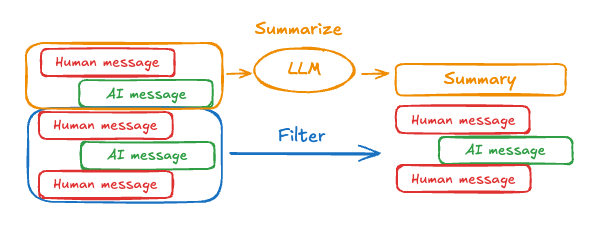
MessagesState
summary
from langgraph.graph import MessagesState class State(MessagesState): summary: str
summarize_conversation
messages
`def summarize_conversation(state: State):
First, we get any existing summary
summary = state.get(“summary”, "")
Create our summarization prompt
if summary:
A summary already exists
summary_message = ( f”This is a summary of the conversation to date: {summary}\n\n” “Extend the summary by taking into account the new messages above:” )
else: summary_message = “Create a summary of the conversation above:“
Add prompt to our history
messages = state[“messages”] + [HumanMessage(content=summary_message)] response = model.invoke(messages)
Delete all but the 2 most recent messages
delete_messages = [RemoveMessage(id=m.id) for m in state[“messages”][:-2]] return {“summary”: response.content, “messages”: delete_messages}`
Full example: summarize messages
`from typing import Any, TypedDict
from langchain.chat_models import init_chat_model from langchain.messages import AnyMessage from langchain_core.messages.utils import count_tokens_approximately from langgraph.graph import StateGraph, START, MessagesState from langgraph.checkpoint.memory import InMemorySaver from langmem.short_term import SummarizationNode, RunningSummary
model = init_chat_model(“claude-sonnet-4-5-20250929”) summarization_model = model.bind(max_tokens=128)
class State(MessagesState): context: dict[str, RunningSummary]
class LLMInputState(TypedDict): summarized_messages: list[AnyMessage] context: dict[str, RunningSummary]
summarization_node = SummarizationNode( token_counter=count_tokens_approximately, model=summarization_model, max_tokens=256, max_tokens_before_summary=256, max_summary_tokens=128, )
def call_model(state: LLMInputState): response = model.invoke(state[“summarized_messages”]) return {“messages”: [response]}
checkpointer = InMemorySaver() builder = StateGraph(State) builder.add_node(call_model) builder.add_node(“summarize”, summarization_node) builder.add_edge(START, “summarize”) builder.add_edge(“summarize”, “call_model”) graph = builder.compile(checkpointer=checkpointer)
Invoke the graph
config = {“configurable”: {“thread_id”: “1”}} graph.invoke({“messages”: “hi, my name is bob”}, config) graph.invoke({“messages”: “write a short poem about cats”}, config) graph.invoke({“messages”: “now do the same but for dogs”}, config) final_response = graph.invoke({“messages”: “what’s my name?”}, config)
final_response[“messages”][-1].pretty_print()
print(“\nSummary:”, final_response[“context”][“running_summary”].summary) context SummarizationNode call_model ================================== Ai Message ==================================
From our conversation, I can see that you introduced yourself as Bob. That’s the name you shared with me when we began talking.
Summary: In this conversation, I was introduced to Bob, who then asked me to write a poem about cats. I composed a poem titled “The Mystery of Cats” that captured cats’ graceful movements, independent nature, and their special relationship with humans. Bob then requested a similar poem about dogs, so I wrote “The Joy of Dogs,” which highlighted dogs’ loyalty, enthusiasm, and loving companionship. Both poems were written in a similar style but emphasized the distinct characteristics that make each pet special.`
Manage checkpoints
View thread state
`config = { “configurable”: { “thread_id”: “1”,
optionally provide an ID for a specific checkpoint,
otherwise the latest checkpoint is shown
”checkpoint_id”: “1f029ca3-1f5b-6704-8004-820c16b69a5a”
}
}
graph.get_state(config) StateSnapshot(
values={‘messages’: [HumanMessage(content=“hi! I’m bob”), AIMessage(content=‘Hi Bob! How are you doing today?), HumanMessage(content=“what’s my name?”), AIMessage(content=‘Your name is Bob.’)]}, next=(),
config={‘configurable’: {‘thread_id’: ‘1’, ‘checkpoint_ns’: ”, ‘checkpoint_id’: ‘1f029ca3-1f5b-6704-8004-820c16b69a5a’}},
metadata={
‘source’: ‘loop’,
‘writes’: {‘call_model’: {‘messages’: AIMessage(content=‘Your name is Bob.’)}},
‘step’: 4,
‘parents’: {},
‘thread_id’: ‘1’
},
created_at=‘2025-05-05T16:01:24.680462+00:00’,
parent_config={‘configurable’: {‘thread_id’: ‘1’, ‘checkpoint_ns’: ”, ‘checkpoint_id’: ‘1f029ca3-1790-6b0a-8003-baf965b6a38f’}},
tasks=(),
interrupts=()
) config = {
“configurable”: {
“thread_id”: “1”,
optionally provide an ID for a specific checkpoint,
otherwise the latest checkpoint is shown
”checkpoint_id”: “1f029ca3-1f5b-6704-8004-820c16b69a5a”
}
}
checkpointer.get_tuple(config) CheckpointTuple(
config={‘configurable’: {‘thread_id’: ‘1’, ‘checkpoint_ns’: ”, ‘checkpoint_id’: ‘1f029ca3-1f5b-6704-8004-820c16b69a5a’}},
checkpoint={
‘v’: 3,
‘ts’: ‘2025-05-05T16:01:24.680462+00:00’,
‘id’: ‘1f029ca3-1f5b-6704-8004-820c16b69a5a’,
‘channel_versions’: {‘start’: ‘00000000000000000000000000000005.0.5290678567601859’, ‘messages’: ‘00000000000000000000000000000006.0.3205149138784782’, ‘branch:to:call_model’: ‘00000000000000000000000000000006.0.14611156755133758’}, ‘versions_seen’: {‘input’: {}, ‘start’: {‘start’: ‘00000000000000000000000000000004.0.5736472536395331’}, ‘call_model’: {‘branch:to:call_model’: ‘00000000000000000000000000000005.0.1410174088651449’}},
‘channel_values’: {‘messages’: [HumanMessage(content=“hi! I’m bob”), AIMessage(content=‘Hi Bob! How are you doing today?), HumanMessage(content=“what’s my name?”), AIMessage(content=‘Your name is Bob.’)]},
},
metadata={
‘source’: ‘loop’,
‘writes’: {‘call_model’: {‘messages’: AIMessage(content=‘Your name is Bob.’)}},
‘step’: 4,
‘parents’: {},
‘thread_id’: ‘1’
},
parent_config={‘configurable’: {‘thread_id’: ‘1’, ‘checkpoint_ns’: ”, ‘checkpoint_id’: ‘1f029ca3-1790-6b0a-8003-baf965b6a38f’}},
pending_writes=[]
)`
View the history of the thread
config = { "configurable": { "thread_id": "1" } } list(graph.get_state_history(config))
[ StateSnapshot( values={'messages': [HumanMessage(content="hi! I'm bob"), AIMessage(content='Hi Bob! How are you doing today? Is there anything I can help you with?'), HumanMessage(content="what's my name?"), AIMessage(content='Your name is Bob.')]}, next=(), config={'configurable': {'thread_id': '1', 'checkpoint_ns': '', 'checkpoint_id': '1f029ca3-1f5b-6704-8004-820c16b69a5a'}}, metadata={'source': 'loop', 'writes': {'call_model': {'messages': AIMessage(content='Your name is Bob.')}}, 'step': 4, 'parents': {}, 'thread_id': '1'}, created_at='2025-05-05T16:01:24.680462+00:00', parent_config={'configurable': {'thread_id': '1', 'checkpoint_ns': '', 'checkpoint_id': '1f029ca3-1790-6b0a-8003-baf965b6a38f'}}, tasks=(), interrupts=() ), StateSnapshot( values={'messages': [HumanMessage(content="hi! I'm bob"), AIMessage(content='Hi Bob! How are you doing today? Is there anything I can help you with?'), HumanMessage(content="what's my name?")]}, next=('call_model',), config={'configurable': {'thread_id': '1', 'checkpoint_ns': '', 'checkpoint_id': '1f029ca3-1790-6b0a-8003-baf965b6a38f'}}, metadata={'source': 'loop', 'writes': None, 'step': 3, 'parents': {}, 'thread_id': '1'}, created_at='2025-05-05T16:01:23.863421+00:00', parent_config={...} tasks=(PregelTask(id='8ab4155e-6b15-b885-9ce5-bed69a2c305c', name='call_model', path=('__pregel_pull', 'call_model'), error=None, interrupts=(), state=None, result={'messages': AIMessage(content='Your name is Bob.')}),), interrupts=() ), StateSnapshot( values={'messages': [HumanMessage(content="hi! I'm bob"), AIMessage(content='Hi Bob! How are you doing today? Is there anything I can help you with?')]}, next=('__start__',), config={...}, metadata={'source': 'input', 'writes': {'__start__': {'messages': [{'role': 'user', 'content': "what's my name?"}]}}, 'step': 2, 'parents': {}, 'thread_id': '1'}, created_at='2025-05-05T16:01:23.863173+00:00', parent_config={...} tasks=(PregelTask(id='24ba39d6-6db1-4c9b-f4c5-682aeaf38dcd', name='__start__', path=('__pregel_pull', '__start__'), error=None, interrupts=(), state=None, result={'messages': [{'role': 'user', 'content': "what's my name?"}]}),), interrupts=() ), StateSnapshot( values={'messages': [HumanMessage(content="hi! I'm bob"), AIMessage(content='Hi Bob! How are you doing today? Is there anything I can help you with?')]}, next=(), config={...}, metadata={'source': 'loop', 'writes': {'call_model': {'messages': AIMessage(content='Hi Bob! How are you doing today? Is there anything I can help you with?')}}, 'step': 1, 'parents': {}, 'thread_id': '1'}, created_at='2025-05-05T16:01:23.862295+00:00', parent_config={...} tasks=(), interrupts=() ), StateSnapshot( values={'messages': [HumanMessage(content="hi! I'm bob")]}, next=('call_model',), config={...}, metadata={'source': 'loop', 'writes': None, 'step': 0, 'parents': {}, 'thread_id': '1'}, created_at='2025-05-05T16:01:22.278960+00:00', parent_config={...} tasks=(PregelTask(id='8cbd75e0-3720-b056-04f7-71ac805140a0', name='call_model', path=('__pregel_pull', 'call_model'), error=None, interrupts=(), state=None, result={'messages': AIMessage(content='Hi Bob! How are you doing today? Is there anything I can help you with?')}),), interrupts=() ), StateSnapshot( values={'messages': []}, next=('__start__',), config={'configurable': {'thread_id': '1', 'checkpoint_ns': '', 'checkpoint_id': '1f029ca3-0870-6ce2-bfff-1f3f14c3e565'}}, metadata={'source': 'input', 'writes': {'__start__': {'messages': [{'role': 'user', 'content': "hi! I'm bob"}]}}, 'step': -1, 'parents': {}, 'thread_id': '1'}, created_at='2025-05-05T16:01:22.277497+00:00', parent_config=None, tasks=(PregelTask(id='d458367b-8265-812c-18e2-33001d199ce6', name='__start__', path=('__pregel_pull', '__start__'), error=None, interrupts=(), state=None, result={'messages': [{'role': 'user', 'content': "hi! I'm bob"}]}),), interrupts=() ) ]
config = { "configurable": { "thread_id": "1" } } list(checkpointer.list(config))
[ CheckpointTuple( config={'configurable': {'thread_id': '1', 'checkpoint_ns': '', 'checkpoint_id': '1f029ca3-1f5b-6704-8004-820c16b69a5a'}}, checkpoint={ 'v': 3, 'ts': '2025-05-05T16:01:24.680462+00:00', 'id': '1f029ca3-1f5b-6704-8004-820c16b69a5a', 'channel_versions': {'__start__': '00000000000000000000000000000005.0.5290678567601859', 'messages': '00000000000000000000000000000006.0.3205149138784782', 'branch:to:call_model': '00000000000000000000000000000006.0.14611156755133758'}, 'versions_seen': {'__input__': {}, '__start__': {'__start__': '00000000000000000000000000000004.0.5736472536395331'}, 'call_model': {'branch:to:call_model': '00000000000000000000000000000005.0.1410174088651449'}}, 'channel_values': {'messages': [HumanMessage(content="hi! I'm bob"), AIMessage(content='Hi Bob! How are you doing today? Is there anything I can help you with?'), HumanMessage(content="what's my name?"), AIMessage(content='Your name is Bob.')]}, }, metadata={'source': 'loop', 'writes': {'call_model': {'messages': AIMessage(content='Your name is Bob.')}}, 'step': 4, 'parents': {}, 'thread_id': '1'}, parent_config={'configurable': {'thread_id': '1', 'checkpoint_ns': '', 'checkpoint_id': '1f029ca3-1790-6b0a-8003-baf965b6a38f'}}, pending_writes=[] ), CheckpointTuple( config={'configurable': {'thread_id': '1', 'checkpoint_ns': '', 'checkpoint_id': '1f029ca3-1790-6b0a-8003-baf965b6a38f'}}, checkpoint={ 'v': 3, 'ts': '2025-05-05T16:01:23.863421+00:00', 'id': '1f029ca3-1790-6b0a-8003-baf965b6a38f', 'channel_versions': {'__start__': '00000000000000000000000000000005.0.5290678567601859', 'messages': '00000000000000000000000000000006.0.3205149138784782', 'branch:to:call_model': '00000000000000000000000000000006.0.14611156755133758'}, 'versions_seen': {'__input__': {}, '__start__': {'__start__': '00000000000000000000000000000004.0.5736472536395331'}, 'call_model': {'branch:to:call_model': '00000000000000000000000000000005.0.1410174088651449'}}, 'channel_values': {'messages': [HumanMessage(content="hi! I'm bob"), AIMessage(content='Hi Bob! How are you doing today? Is there anything I can help you with?'), HumanMessage(content="what's my name?")], 'branch:to:call_model': None} }, metadata={'source': 'loop', 'writes': None, 'step': 3, 'parents': {}, 'thread_id': '1'}, parent_config={...}, pending_writes=[('8ab4155e-6b15-b885-9ce5-bed69a2c305c', 'messages', AIMessage(content='Your name is Bob.'))] ), CheckpointTuple( config={...}, checkpoint={ 'v': 3, 'ts': '2025-05-05T16:01:23.863173+00:00', 'id': '1f029ca3-1790-616e-8002-9e021694a0cd', 'channel_versions': {'__start__': '00000000000000000000000000000004.0.5736472536395331', 'messages': '00000000000000000000000000000003.0.7056767754077798', 'branch:to:call_model': '00000000000000000000000000000003.0.22059023329132854'}, 'versions_seen': {'__input__': {}, '__start__': {'__start__': '00000000000000000000000000000001.0.7040775356287469'}, 'call_model': {'branch:to:call_model': '00000000000000000000000000000002.0.9300422176788571'}}, 'channel_values': {'__start__': {'messages': [{'role': 'user', 'content': "what's my name?"}]}, 'messages': [HumanMessage(content="hi! I'm bob"), AIMessage(content='Hi Bob! How are you doing today? Is there anything I can help you with?')]} }, metadata={'source': 'input', 'writes': {'__start__': {'messages': [{'role': 'user', 'content': "what's my name?"}]}}, 'step': 2, 'parents': {}, 'thread_id': '1'}, parent_config={...}, pending_writes=[('24ba39d6-6db1-4c9b-f4c5-682aeaf38dcd', 'messages', [{'role': 'user', 'content': "what's my name?"}]), ('24ba39d6-6db1-4c9b-f4c5-682aeaf38dcd', 'branch:to:call_model', None)] ), CheckpointTuple( config={...}, checkpoint={ 'v': 3, 'ts': '2025-05-05T16:01:23.862295+00:00', 'id': '1f029ca3-178d-6f54-8001-d7b180db0c89', 'channel_versions': {'__start__': '00000000000000000000000000000002.0.18673090920108737', 'messages': '00000000000000000000000000000003.0.7056767754077798', 'branch:to:call_model': '00000000000000000000000000000003.0.22059023329132854'}, 'versions_seen': {'__input__': {}, '__start__': {'__start__': '00000000000000000000000000000001.0.7040775356287469'}, 'call_model': {'branch:to:call_model': '00000000000000000000000000000002.0.9300422176788571'}}, 'channel_values': {'messages': [HumanMessage(content="hi! I'm bob"), AIMessage(content='Hi Bob! How are you doing today? Is there anything I can help you with?')]} }, metadata={'source': 'loop', 'writes': {'call_model': {'messages': AIMessage(content='Hi Bob! How are you doing today? Is there anything I can help you with?')}}, 'step': 1, 'parents': {}, 'thread_id': '1'}, parent_config={...}, pending_writes=[] ), CheckpointTuple( config={...}, checkpoint={ 'v': 3, 'ts': '2025-05-05T16:01:22.278960+00:00', 'id': '1f029ca3-0874-6612-8000-339f2abc83b1', 'channel_versions': {'__start__': '00000000000000000000000000000002.0.18673090920108737', 'messages': '00000000000000000000000000000002.0.30296526818059655', 'branch:to:call_model': '00000000000000000000000000000002.0.9300422176788571'}, 'versions_seen': {'__input__': {}, '__start__': {'__start__': '00000000000000000000000000000001.0.7040775356287469'}}, 'channel_values': {'messages': [HumanMessage(content="hi! I'm bob")], 'branch:to:call_model': None} }, metadata={'source': 'loop', 'writes': None, 'step': 0, 'parents': {}, 'thread_id': '1'}, parent_config={...}, pending_writes=[('8cbd75e0-3720-b056-04f7-71ac805140a0', 'messages', AIMessage(content='Hi Bob! How are you doing today? Is there anything I can help you with?'))] ), CheckpointTuple( config={'configurable': {'thread_id': '1', 'checkpoint_ns': '', 'checkpoint_id': '1f029ca3-0870-6ce2-bfff-1f3f14c3e565'}}, checkpoint={ 'v': 3, 'ts': '2025-05-05T16:01:22.277497+00:00', 'id': '1f029ca3-0870-6ce2-bfff-1f3f14c3e565', 'channel_versions': {'__start__': '00000000000000000000000000000001.0.7040775356287469'}, 'versions_seen': {'__input__': {}}, 'channel_values': {'__start__': {'messages': [{'role': 'user', 'content': "hi! I'm bob"}]}} }, metadata={'source': 'input', 'writes': {'__start__': {'messages': [{'role': 'user', 'content': "hi! I'm bob"}]}}, 'step': -1, 'parents': {}, 'thread_id': '1'}, parent_config=None, pending_writes=[('d458367b-8265-812c-18e2-33001d199ce6', 'messages', [{'role': 'user', 'content': "hi! I'm bob"}]), ('d458367b-8265-812c-18e2-33001d199ce6', 'branch:to:call_model', None)] ) ]
Delete all checkpoints for a thread
thread_id = "1" checkpointer.delete_thread(thread_id)
Database management
setup()
BaseCheckpointSaver
BaseStore
Was this page helpful?
Resources
Company